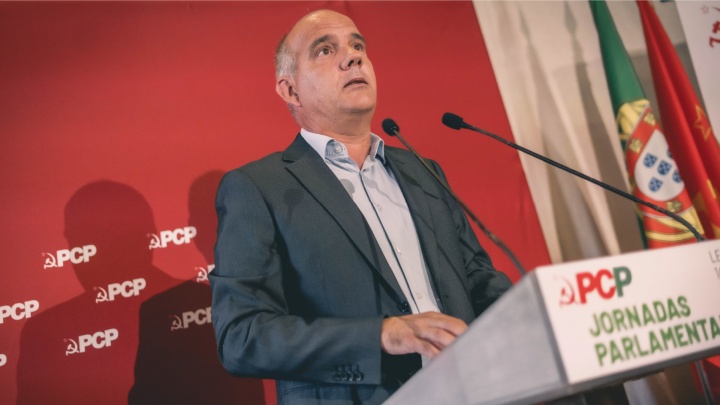
Dear comrades,
Ladies and gentlemen of the press,
Please allow me to begin this speech by thanking all the bodies, organisations and grassroots associations we have been in contact with, who have also helped to shape our Parliamentary Conference, and to offer a special mention to the PCP organisations in the districts of Coimbra and Leiria, and in particular to our comrades in Marinha Grande, who, together with the parliamentary group, ensured and made possible this Conference that is now coming to a close.
We held this Conference in the districts of Leiria and Coimbra because we have not forgotten – and will not allow – the consequences of the severe storms that ravaged the country, and the central region in particular, to fall into oblivion.
We have returned to a place we never left, and here we have revisited the devastation caused; we have returned to take stock of the reconstruction of damaged infrastructure, of the support provided to communities and businesses, to assess the progress made in restoring the living conditions that were affected, and the return to normality in economic, social and cultural activities; we have also returned with our eyes set on new challenges, first and foremost the wildfires, which have so dramatically ravaged these lands.
We chose the PCP’s Work Centre in Marinha Grande as the venue for these events – an unprecedented choice, but one of great significance.
It was here, at this Work Centre– itself severely damaged by the storms – that the PCP in Marinha Grande immediately set up, just as many other institutions, individuals and organisations did, a centre to support the local population, providing meals and accommodation to those in need.
A party that knows – and reality proves this – that only the strength of the people can save the people.
And it was, and remains, this very strength of the people who refuse to accept the rising cost of living, who want Peace and will not tolerate the dismantling of the National Health Service, who reject unaffordable housing prices and growing injustice and inequality, and who unequivocally reject a labour package tailored to the interests of economic groups – for which the PSD, CDS, Chega and IL act as spokespeople – with a government acting hastily and against the interests of workers, forcing the debate without any regard for the 30-day public consultation period.
A declaration of war on workers, which will be debated and voted in Parliament this coming Thursday and Friday.
Now is the moment of truth; every party will have to face up to its responsibilities towards the Country and towards the workers.
Every MP and every party will have to decide whether to defeat or let pass even greater precariousness, even greater deregulation of working hours and of people’s lives, even greater pressure on wages, greater vulnerability, greater exploitation, the liberalisation of dismissals, the permission to use outsourcing to replace dismissed workers, individual hour banks, and the attack on the right to strike and trade union action.
Every MP and every party will have to decide whether to defeat or let pass a labour package rejected by working people – by those who are already struggling to make ends meet on low wages, who are already subject to brutal levels of job precariousness, and who are already facing long working hours and the deregulation of working hours.
Every MP and every party will have to decide whether to defeat or let pass this attack on workers; this, and this alone, is what is at stake; it is this choice, and this choice alone, that will have to be made in the coming days.
Workers’ rights and lives are not for sale, nor are they a bargaining chip for anything.
If the labour package does not serve the workers, the youth or the Country, there is only one possible course of action: to defeat it.
The only way to oppose the labour package is to vote against a proposal which contains not a single measure that resolves any of the problems already affecting workers today; on the contrary, everything it proposes serves only to further worsen the situation of workers.
And for anyone who might think they can pull off a stunt – as they did during the Constitutional amendment or with the most recent backroom deal between Chega and the PSD over the Single Social Benefit – and thereby avoid a general debate, ensuring the labour package is referred back to committee without a vote, let this serve as a warning: anyone who promotes or associates themselves with this ploy is facilitating the progress of the labour package, and workers will draw their own conclusions from that choice.
Big employers, the parties at their service and the current government have opened Pandora’s box of attacks on workers, and now the workers will not let them off the hook until the labour package is defeated.
We must defeat the labour package and remove the grievous provisions that already exist in the Labour Code, at the outset with the repeal of the expiry of collective agreements, the restoration of the principle of the most favourable treatment for workers and of the rates payable for overtime, the fight against precarious employment and the strengthening of rights; this is the direction of the PCP’s action.
It is this path of respect, dignity, rights, stability and development that is required, and it is this that provides the answer to the Country’s problems.
And it is the answers – or rather the lack of them – that have brought us to these lands and into contact with these people. Almost half a year after the storms, most of the Government’s promises remain unfulfilled.
They said that this time it would happen, that support would arrive within a few days, that there would be no red tape, but what we have found is that the support has not arrived, that people are still left to fend for themselves, that the damaged homes, equipment and infrastructure remain, for the most part, unrepaired, and that far too many applications are still awaiting assessment.
What we have seen is the vast majority of fallen timber still lying uncollected, hundreds of blocked tracks and inaccessible routes.
With summer just around the corner and at a time when an extraordinary mobilisation of resources was needed to protect the forest and the rural world whilst there is still time, we have a Government relying on luck.
A Government that first ignored the warnings issued by the PCP as early as the beginning of February, then dragged its feet, passed the buck to local authorities, and continued to do what it does best: announcing and re-announcing what it had already announced, whilst practically nothing had been achieved.
The storms did indeed come, just as the PCP had warned, clearly exposing the consequences of the liberalisation and privatisation of strategic sectors and the weaknesses of a State lacking the means and resources to mobilise and intervene.
Faced with the tragedy that struck and the brutal lack of response still felt today from electricity companies, telecoms firms, insurers and motorway concessionaires, there were those who were quick to say that the State had failed.
What has failed, yet again, is the Government’s policy, which leaves the Country at the mercy of the greed of shareholders in strategic companies – formerly public – which should, in fact, be bringing electricity into people’s homes, ensuring communications, protecting the populations and businesses against unforeseen risks, and not acting solely in the interests of dividends.
May this eye-opening experience serve as a lesson and provide further reason to thwart the Government’s plans which, with the support of Chega and the IL – and perhaps even the PS – seek to hand over hospitals, healthcare centres, railway lines and TAP to big capital, making the Country even more dependent and leaving it with even less capacity to respond.
In the face of these dramatic events, what was needed was to safeguard workers’ incomes and support small farmers, provide non-repayable grants to micro and small businesses, and guarantee 100 % funding for the restoration of public facilities and community centres, private social welfare organisations or the fire fighters – all of this was proposed by the PCP; all of this was rejected by the PSD, IL and CDS; and the abstentions by Chega and the PS rendered it unviable.
All of this was what was needed; it is all of this that is still required today, as we have seen during this Parliamentary Conference, during which we have been in contact with people who have suffered losses that have yet to be remedied, and with local councillors who, to the best of their ability, have done and continue to do their utmost to help the local populations.
What we have witnessed and heard over the last few days amounts to a veritable verdict of condemnation against a government that is continuing, intensifying and accelerating a process of dismantling the State, with consequences for people’s daily lives; one need only look at the outcome, for example, of the dismantling of public management of the hydro-agricultural system.
The Government made many announcements, but each new announcement was merely a propaganda stunt.
Local municipalities and parishes did not receive the support they had been promised – and which was necessary to deal with the most serious situations – and everything they were able to do was achieved solely through their own resources.
Insurance companies, which have long refused to insure various realities – not least businesses in bathing sites – adopted their usual stance in the face of the situation, using every possible subterfuge to avoid taking responsibility.
In the forest, it looks as though the storms struck only yesterday, such is the extent of the visible devastation; this gives rise to serious concerns, given that we are now in the peak season for rural fires.
There is a lack of human, technical and financial resources to restore the devastated areas; not only is it impossible to restore what once existed, but the Country is also left more vulnerable to further tragedies.
The situation that has arisen requires an assessment of all possible measures to mobilise exceptional resources and means that can provide an immediate response to matters of great urgency that cannot wait any longer.
To this end, the PCP will table proposals in the Assembly of the Republic that address:
- the urgent mobilisation and formation of teams to speed up the processing of thousands of applications that are still pending;
- the need for the rapid mobilisation of means and resources to carry out urgent land clearing;
- non-repayable support schemes for businesses;
- the mobilisation of resources to restore equipment and facilities belonging to local community centres, private social welfare institutions (IPSS) and the fire fighters;
- the protection of the significant cultural heritage that has been affected.
The drama caused by the storms, coupled with the lack of coordination and a swift response, further highlighted one of the causes of the Country’s structural backwardness, namely the lack of administrative regions.
Everyone mourned the excessive centralisation of public administration and the lack of regional development policies, which severely penalise the Country’s inland regions; everyone delivered meaningful speeches against the worsening of regional asymmetries and the depopulation of the interior, and many acknowledged the lack of administrative regions on mainland Portugal.
And if that is the case, let us then turn this need into reality.
It is time to return to discussing regionalisation in a serious and responsible manner.
To this end, I would like to announce that, on June 24, the PCP will table its proposals on the creation of administrative regions for debate in the Assembly of the Republic.
The draft framework bill on administrative regions, so that the powers and responsibilities currently held by the CCDRs are transferred to the regions to be created; and the draft resolution proposing a work programme and a timetable of actions aimed at the creation and concrete establishment of the administrative regions, comprising the following phases:
- by the end of 2026, so that the Assembly of the Republic may hear from those it needs to consult regarding the process of creating the administrative regions;
- by mid-2027, so that local authorities may give their views on the map to be put to a referendum;
- and by the end of 2027, for the Assembly of the Republic to approve the proposed questions to be put to a referendum to be held by the end of July 2028.
If this is the will of the Portuguese people, regionalisation will become a reality in Portugal within two years, with the election of its representative bodies during the 2029 local elections.
The question is not whether or not this is a priority; the question is whether, in the face of future dramas, we will once again mourn what could and should have been done.
We emerge from this Conference with increased responsibilities, which we accept with a commitment to follow up in the Assembly of the Republic on the various issues we have addressed here, using the various instruments at our disposal
Demanding from the Government the necessary responses that are long overdue, putting forward concrete solutions to resolve the problems being felt, and carrying out institutional action that is recognised, respected and valued – action that forms part of the struggle for radical change, following the path of hope which prioritises workers and the populations and their needs, and which defends and serves the public interest and the Country’s development – that is the commitment we have reaffirmed during this parliamentary Conference.